Forensic Psychiatric Nurse Practitioner: Jobs, Pay, Path
What a forensic psychiatric nurse practitioner does in jails, prisons and forensic hospitals, what the job pays by employer, and how to become one.
Published
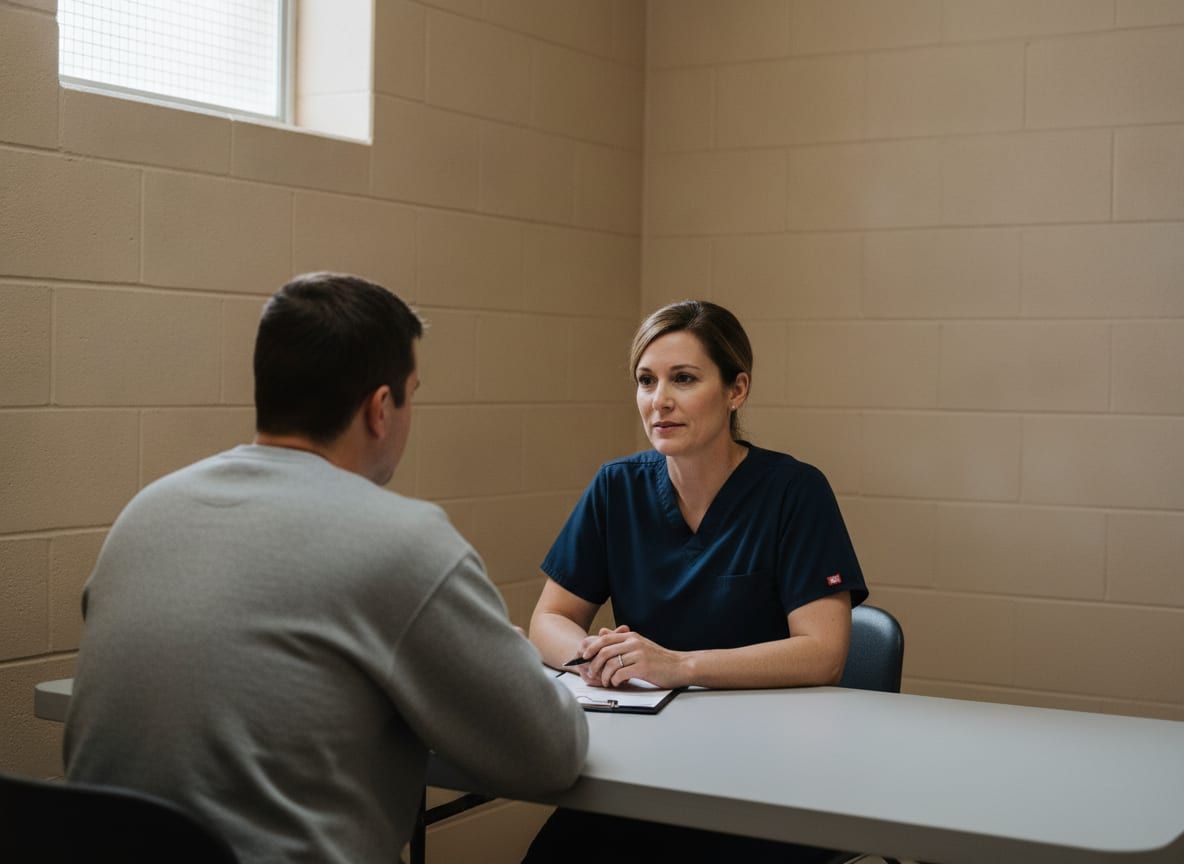
A forensic psychiatric nurse practitioner is a psychiatric-mental health nurse practitioner (PMHNP) who works where mental health care meets the legal system. That means jails and prisons, state forensic hospitals, juvenile detention centers and court-linked treatment programs. The work is the same core job as any PMHNP: evaluate, diagnose, prescribe and manage psychiatric treatment. The patients are people who are in custody, awaiting trial or under a court order.
"Forensic" isn't a separate license, degree or board exam. There's no forensic PMHNP certification to sit. You become a PMHNP first, then move into forensic settings through the jobs you take. This guide covers what the work involves, how it differs from the other kind of forensic nurse, what it pays by employer, and the route in.
The two jobs searchers mean by "forensic nurse practitioner". Sources are linked in the sections below.
| Forensic psychiatric NP | Forensic nurse examiner (SANE) | |
|---|---|---|
| Patients | People in jails, prisons, forensic hospitals and court programs who have a mental illness | Victims of sexual assault, abuse and other violence |
| Core work | Psychiatric evaluation, diagnosis, prescribing, competency restoration | Medical forensic exams, evidence collection, injury documentation |
| License needed | APRN license with PMHNP certification | RN license (many are RNs, some are NPs) |
| Key credential | PMHNP-BC (ANCC) | SANE-A or SANE-P |
| Can prescribe psychiatric medication | Yes | Only if also licensed as an NP |
Two Jobs Share the Name "Forensic Nurse Practitioner"
Search for "forensic nurse practitioner" and most results describe a different job. Most forensic nurses are sexual assault nurse examiners (SANEs). They care for victims of assault and abuse, perform medical forensic exams, and collect and document evidence that may be used in court. Many are registered nurses, and some are nurse practitioners.
The standard credentials for that work are SANE-A, for adult and adolescent patients, and SANE-P, for children. Both require RN experience, a SANE training course and supervised examiner practice before you can sit the exam. They certify skill in caring for victims, not psychiatric practice.
A forensic psychiatric nurse practitioner works on the other side of the system, mostly with people accused or convicted of crimes who have a mental illness. The job runs on psychiatric training and prescriptive authority, not evidence collection. If that's the job you mean, the PMHNP route is the one that leads there.
What a Forensic Psychiatric Nurse Practitioner Does
The settings shape the work. Most forensic PMHNP jobs fall into one of four:
- Jails. Short stays and constant turnover. Much of the work is intake: screening new arrivals, continuing or restarting medications, managing withdrawal, and spotting people at risk of suicide. You may see someone once before they're released or moved.
- Prisons. Longer sentences mean ongoing care. You manage chronic conditions like schizophrenia, bipolar disorder and depression over months or years, often for a large caseload, and coordinate with the facility's psychologists and custody staff.
- State forensic hospitals. These units treat people a court has found incompetent to stand trial or not guilty by reason of insanity. A large part of the work is competency restoration: treating the illness, often with medication, until the person can understand the charges and help with their defense.
- Courts and community programs. Mental health courts, diversion programs and post-release clinics need prescribers who can keep people stable and in treatment so they stay out of custody.
Every setting has the same constraint: security comes first. Medication passes, appointments and even the kinds of drugs on the formulary are shaped by custody rules. Expect a formulary that can be narrower than an outpatient clinic's, and ask about it in the interview.
Can a PMHNP Do Competency Evaluations?
Usually not as the court's evaluator. The court-ordered evaluation of whether a defendant is competent to stand trial is mostly reserved for psychiatrists and psychologists, and each state sets the rule in its criminal code. Texas is a clear example. Article 46B.022 of its Code of Criminal Procedure requires the appointed expert to be a licensed physician or a licensed psychologist with a doctoral degree in psychology. The expert also needs board certification in forensic psychiatry or forensic psychology, or at least 24 hours of specialized forensic training plus 8 hours of recent continuing education.
That doesn't sideline PMHNPs. They do much of the treatment around the evaluation: the psychiatric care in jail before a hearing, the medication management that restores competency in a forensic hospital, and the follow-up after release. If testifying as an expert is the part of forensic work that draws you, check your state's competency statute before you choose a degree. In many states that role needs a psychiatrist or psychologist.
Why Jails and Prisons Need Psychiatric Prescribers
The numbers come from a national survey of people behind bars. In the Bureau of Justice Statistics' most recent report on the subject, 37% of state and federal prisoners and 44% of jail inmates said a mental health professional had told them they had a mental disorder. About 14% of prisoners and 26% of jail inmates met the threshold for serious psychological distress in the past 30 days.
Treatment lagged behind. Among those in serious distress, 54% of prisoners and only 35% of jail inmates had received any mental health treatment since arriving at their current facility. Prescription medication was the most common treatment: 46% of prisoners and 30% of jail inmates in serious distress had received it. Prescribing is the service most needed in these settings, and it's the one a PMHNP is licensed to provide.
The survey ran in 2011-12 and BJS published it in June 2017. It's self-reported, so it isn't a count of clinical diagnoses. It's still the most recent federal estimate of its kind.
Forensic Psychiatric Nurse Practitioner Salary
BLS doesn't publish a forensic figure, or a psychiatric one, for nurse practitioners. It does publish NP pay by employer type, and forensic work sits inside a few of them:
Nurse practitioner pay by employer type, BLS OEWS, May 2025. BLS covers all nurse practitioners and has no forensic or psychiatric figure.
| Employer type | Median | 10th to 90th percentile | NPs employed |
|---|---|---|---|
| Psychiatric and substance abuse hospitals | $148,850 | $106,220 to $199,790 | 2,900 |
| Local government (excluding schools and hospitals) | $134,400 | $101,340 to $172,910 | 3,300 |
| All employers | $132,300 | $101,340 to $174,420 | 323,040 |
| State government (excluding schools and hospitals) | $120,230 | $93,120 to $165,170 | 1,380 |
The spread is wide. Psychiatric hospitals pay a median of $148,850, above the national NP median of $132,300. BLS counts state-run hospitals, including state forensic hospitals, with the hospital industries rather than with state government. State government agencies, which include state prison systems, pay a median of $120,230. That's $28,620 less than psychiatric hospitals and below the national median. Local government, which includes county jails, sits at $134,400.
These figures have limits. The government rows count every nurse practitioner in those agencies, not only those in corrections, and they cover all specialties. Some jails and prisons also contract their health care to private companies, whose staff BLS counts under other industries. Government jobs often carry pension and benefit packages that a salary median doesn't show. For more on how setting changes PMHNP pay, see our PMHNP salary by setting guide.
How to Become a Forensic Psychiatric Nurse Practitioner
- Become a registered nurse. Earn a nursing degree and pass the NCLEX-RN. A bachelor's degree (BSN) is the standard entry point for graduate programs. Psychiatric or correctional nursing experience helps you get hired later, and many forensic PMHNPs start as psychiatric RNs. Our psychiatric nurse career guide covers that first step.
- Complete a PMHNP program. An MSN, DNP or post-master's certificate in psychiatric-mental health. Ask programs whether they can place you in a correctional or forensic clinical rotation. Few advertise it, but a forensic placement is the strongest thing you can put on a first application. Compare programs in our PMHNP program rankings.
- Pass the PMHNP board exam. ANCC requires at least 500 faculty-supervised clinical hours to sit the exam. Passing earns the PMHNP-BC credential. See our PMHNP certification guide.
- Get licensed and registered. Apply for APRN licensure in your state and a DEA registration for controlled substances. Practice authority varies: the AANP practice environment map shows which states require a physician agreement, and our state requirements guide lists the rule for each.
- Move into forensic work. Apply to jails, prisons, state forensic hospitals and the companies that contract with them. If your clinical placements were thin, a postgraduate residency gives you a supervised year of psychiatric practice before you apply. Our PMHNP residency directory covers the programs.
Optional Forensic Certifications
No state requires a forensic credential to practice as a PMHNP in a forensic setting. Two options exist if you want one:
- AFN-C (Advanced Forensic Nurse - Certified) from the Forensic Nursing Certification Board. It's for licensed RNs with a graduate degree or certificate who practice in forensic nursing or one of its subspecialties. The board publishes the hour requirements in its candidate handbook.
- SANE-A or SANE-P, covered above. These fit if your forensic work includes caring for victims of violence, which is a different job from forensic psychiatry.
You may see the ANCC's AFN-BC listed in older guides. ANCC no longer issues it: its Advanced Forensic Nursing page says the credential is "available for renewal only", every 5 years, for people who already hold it.
Is Forensic Psychiatric Work Right for You?
The draws are real. The BJS figures above show how much untreated mental illness sits in jails and prisons, and prescribing is the gap a PMHNP fills. The cases are clinically complex, with serious mental illness, substance use and trauma often in the same patient. If you want your work to keep people out of a cycle of arrest and release, few psychiatric jobs put you closer to it.
The downsides are real too. You work under security rules that limit how and when you see patients, and some patients are violent. Caseloads in corrections can be heavy. Patients may say they have symptoms to get medication or a transfer, and you'll have to tell when that's happening. Pay depends heavily on who employs you: on the BLS figures above, a state agency job pays well below a psychiatric hospital job. Visit a facility or talk to someone who works in one before you commit.
If you're still choosing a program, start with our PMHNP program rankings, or the online PMHNP rankings if you need to keep working while you study. For the inpatient side of psychiatric work, which overlaps with forensic hospitals, see our inpatient PMHNP career guide.
PMHNP questions, answered
What is a forensic psychiatric nurse practitioner?+
How much does a forensic psychiatric nurse practitioner make?+
Is there a forensic PMHNP certification?+
Is a forensic nurse practitioner the same as a SANE?+
Every figure on this page traces to a primary source.
- [1] BLS, Occupational Employment and Wage Statistics, May 2025: nurse practitioners (29-1171) in all industries, psychiatric and substance abuse hospitals (NAICS 622200), and state and local government excluding schools and hospitals Verified 2026-10-13
- [2] BLS, OEWS overview: survey scope excludes the self-employed and owners Verified 2026-10-05
- [3] Bureau of Justice Statistics, Indicators of Mental Health Problems Reported by Prisoners and Jail Inmates, 2011-12 (NCJ 250612) Verified 2026-10-13
- [4] Texas Code of Criminal Procedure Art. 46B.022: qualifications of experts appointed to evaluate competency Verified 2026-10-13
- [5] ANCC, Advanced Forensic Nursing (AFN-BC): available for renewal only Verified 2026-10-13
- [6] Forensic Nursing Certification Board, certification types: GFN-C and AFN-C Verified 2026-10-13
- [7] ANCC, Psychiatric-Mental Health Nurse Practitioner (Across the Lifespan) certification: eligibility and the 500-hour faculty-supervised clinical minimum Verified 2026-08-31
- [8] AANP, State Practice Environment: NP practice authority by state (updated 05/2026) Verified 2026-06-30
Keep going
Explore PMHNP programs
Ready to take the next step? Browse our expert-ranked program listings.